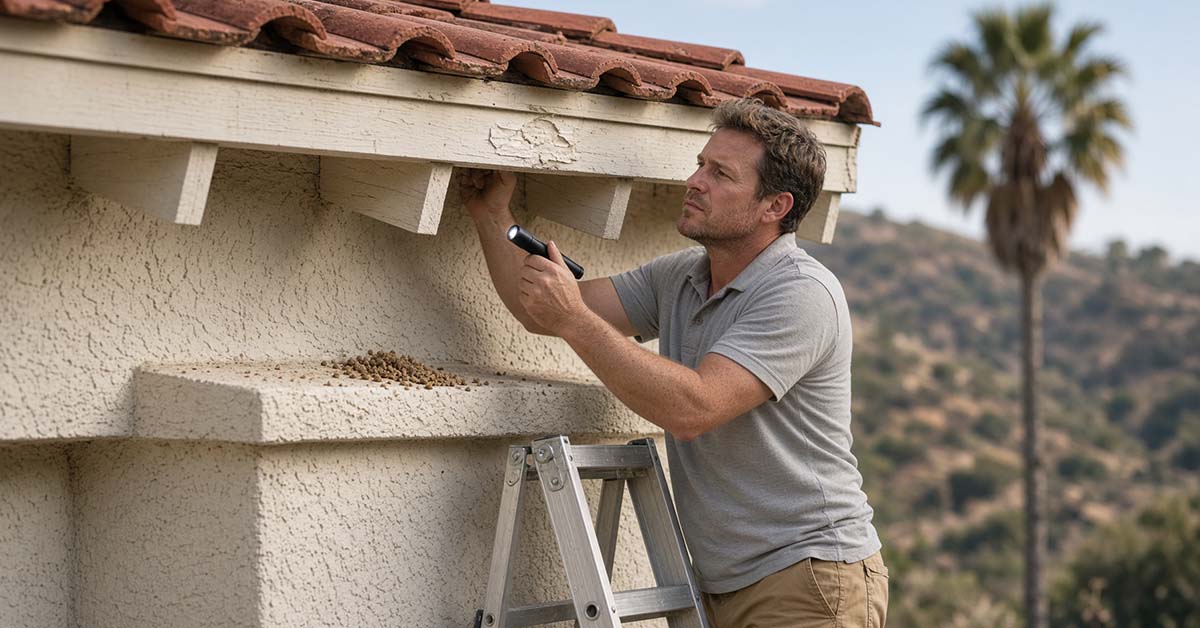
California’s mild climate, well-aged housing stock, and abundant landscaping make the state one of the most active regions in the country for termites and other wood-destroying organisms. As an InterNACHI-certified home inspector working in Ventura County, evidence of pest and fungal damage is one of the most common findings in any pre-2000 home—and one of the most consequential, both for the structural integrity of the building and for the real estate transaction itself.
This article walks through what wood-destroying organisms are most common in California, how to recognize the visual evidence each leaves behind, what a general home inspection covers in this area, and how the inspection interacts with California’s separate, regulated Section 1 pest report.
The Two Termite Species That Matter Most in California
California is home to multiple termite species, but two account for the overwhelming majority of damage in residential structures: drywood termites and subterranean termites. They behave differently, leave different evidence, and require different treatment approaches.
Drywood Termites
Drywood termites live entirely within the wood they consume. They do not require contact with soil, do not build mud tubes, and do not need an external moisture source—they extract enough water from the cellulose itself. Western drywood termites (Incisitermes minor) are particularly common in Southern and coastal California, where they are well-adapted to the climate.
Visual evidence of a drywood infestation:
- Frass (fecal pellets). Drywood termites push their pellets out of the wood through small “kick-out holes” the size of a pinhead. The pellets accumulate below in small piles—six-sided, granular, roughly the size of coarse ground pepper, often described as resembling tiny rabbit droppings or coffee grounds. Frass is the single most diagnostic sign of drywood termites.
- Kick-out holes. Tiny round holes in wood surfaces, often clustered along grain lines or near joints.
- Hollow-sounding wood. Tapping suspect wood with the handle of a flashlight produces a distinctly papery, hollow sound when galleries are present below the surface.
- Blistered or sagging wood surfaces. As galleries widen, the surface layer thins and may develop visible blisters, ripples, or sags.
- Discarded wings. Drywood termite swarmers shed their wings after a brief mating flight; piles of small, equally-sized translucent wings near windows or interior light sources are a classic post-swarm sign.
In Ventura County, I find drywood evidence most often in attic framing, exposed roof rafters, fascia boards, exterior trim, window and door frames, and wood siding. Coastal homes in older parts of Ventura, Oxnard, and Ojai are particularly susceptible.
Subterranean Termites
Subterranean termites (Reticulitermes hesperus is the dominant species in California) live in colonies in the soil and travel up into structures through enclosed mud tubes that protect them from desiccation. They require contact with soil moisture and will retreat when their tubes are broken, returning later to rebuild.
Visual evidence of a subterranean infestation:
- Mud tubes. Earthen pencil-thick tunnels built up from the soil onto foundation walls, piers, posts, and framing. They are reddish-brown, irregular, and unmistakably constructed rather than naturally formed. Active tubes feel slightly damp; abandoned tubes are dry and brittle.
- Damaged wood with intact paint. Subterranean termites consume wood from the inside, often leaving the paint or finish layer largely intact even after the wood underneath is heavily compromised. The result is wood that looks fine but pushes inward when probed.
- Galleries that follow the grain. Internal damage typically follows the soft spring growth of the wood, leaving the harder summer growth as thin partitions—a layered, lasagna-like internal pattern.
- Mud or soil within damaged wood. Subterranean termites carry soil into their galleries, distinguishing their damage from that of drywood termites or wood-decay fungi.
- Swarmers and shed wings. Same general signs as drywood, though the swarming season and behavior differ slightly.
I find subterranean termite evidence most often in crawlspaces, sub-floor framing, mudsills, posts and piers, exterior wood near grade, and any wood that contacts or comes close to soil—the same areas covered in detail in our grading and foundation drainage guide, since wood-to-soil contact and faulty grading are the conditions that most commonly invite subterranean infestation in the first place.
Other Wood-Destroying Organisms in California
Termites get the headlines, but they are not the only category that matters in a California home inspection.
Wood-Decay Fungi (Dry Rot, White Rot, Brown Rot)
Wood-decay fungi require a moisture source and—despite the misleading common name “dry rot”—wood that has been wetted at some point. The major categories:
- Brown rot. Decays cellulose, leaving a darker, shrunken, cubically-cracked residue that crumbles easily into a dark powder. Common in framing exposed to chronic moisture from leaks or condensation.
- White rot. Decays both cellulose and lignin, leaving a softer, lighter, fibrous, stringy residue. Common in exterior wood with cyclic wetting and drying.
- Soft rot. A surface decay typically associated with very wet conditions, leaving a soft outer layer over sound interior wood.
Fungal damage is often misidentified as termite damage and vice versa. The distinguishing question is usually moisture history—where is the water coming from, and how long has it been a problem?
Powderpost Beetles and Other Wood-Boring Beetles
Powderpost beetles, deathwatch beetles, and other wood-boring beetles leave small round exit holes and very fine, talcum-powder-like frass that differs from termite frass in texture. They are less common than termites in California residential structures but show up periodically, particularly in older hardwood framing or imported lumber.
Carpenter Ants
Carpenter ants do not consume wood, but they excavate galleries within damp or decayed wood for their colonies, contributing to structural damage. They are less common in Southern California than in cooler, wetter parts of the country but are not unheard of in Ventura County, especially in areas adjacent to chronic moisture.
What an InterNACHI Inspection Covers—and Where It Hands Off
This is where the line between a general home inspection and California’s Section 1 pest report becomes important, because the two services overlap in obvious ways and confuse a lot of buyers.
The General Home Inspection
As an InterNACHI inspector, I observe and report visible evidence of wood-destroying organisms during my walk-through:
- I document mud tubes, frass piles, kick-out holes, fungal damage, blistered or hollow-sounding wood, and any other visual signs of active or past infestation.
- I report what I see in the locations I can access—attic, crawlspace, exterior, accessible interior framing, garage, and so on.
- I recommend a separate Section 1 pest inspection by a licensed structural pest control inspector when findings warrant it, when the buyer is using FHA or VA financing (which typically requires a pest report), or simply when the home’s age and conditions make it prudent.
The California Section 1 Pest Report
The Section 1 pest report is a separate, regulated service performed by a licensed structural pest control operator under the authority of California’s Structural Pest Control Board. It is not part of, and not a substitute for, a general home inspection. The two have different scopes, different licensure, and different regulatory frameworks.
The pest report categorizes findings:
- Section 1 findings are areas of active infestation, active infection by wood-destroying organisms, or related damage. These are the items most often required to be corrected before close of escrow under many financing programs and many real estate contracts.
- Section 2 findings are conditions that are likely to lead to infestation or infection if left uncorrected—such as wood-to-soil contact, faulty grade, leaking plumbing creating moisture, or earth-to-wood deck supports. These are typically advisory rather than mandatory under standard real estate contracts.
A pest report is performed under different physical access standards than a general home inspection—licensed pest inspectors may probe and sound suspect wood more aggressively, including with sharp tools that a general inspector would not use during a non-invasive evaluation. The report itself is filed with the Structural Pest Control Board and becomes a formal record of the property.
Why You Often Need Both
A common misconception is that a Section 1 pest inspection covers what a home inspection covers, or vice versa. They do not. The home inspection evaluates the full house—roof, electrical, plumbing, HVAC, foundation, structural framing, water management, safety items—while flagging visible WDO evidence. The pest report evaluates wood-destroying organisms specifically, and only WDO, with the licensure, tools, and probing techniques specific to that scope. For an older California home or any transaction subject to FHA or VA financing, both services typically apply.
For a broader picture of what tends to surface in older California housing stock alongside WDO findings, see our overview of common issues in older California homes.
Treatment: Briefly, So You Know What’s on the Table
Treatment options vary by species and extent of damage. A few general categories:
- Drywood termites. Localized treatments include heat, freezing (in some cases), microwave systems, and orange-oil products for confined infestations. For widespread drywood infestations, structural fumigation (“tenting”) remains the most thorough approach. The standard fumigant in California is sulfuryl fluoride—marketed under brand names including Vikane and Zythor—which has been a restricted-use pesticide handled exclusively by licensed structural fumigators for decades. (Roughly 100,000 sulfuryl fluoride fumigations are performed in California each year, the majority for drywood termites.)
- Subterranean termites. Soil-applied liquid termiticides creating a chemical barrier around the foundation, and bait station systems that intercept and eliminate the colony, are the two main approaches. Both require licensed pest control operators.
- Wood-decay fungi. Treatment is moisture control—identify and correct the water source, then replace damaged wood. Surface fungicides have a role for stabilization but do not solve the underlying problem.
- Other pests. Powderpost beetles, carpenter ants, and other less-common organisms each have specific treatment protocols best chosen by a licensed pest control operator.
In all cases, treatment is the pest control operator’s domain. As an inspector, I report findings, recommend further evaluation, and note any visible attempt at past treatment (residual mud tubes broken open and not rebuilt, signs of past tenting, treated termite-bait stations around the perimeter, etc.).
For Buyers
If you are considering an offer on an older California home, plan for a pest report alongside your general home inspection. Many home inspection companies coordinate with a licensed Section 1 pest inspector so both services can be performed at the same property visit. The cost is modest, the information is decisive, and the report often becomes a basis for negotiation if Section 1 items are found. (For why an unhurried general inspection matters in California—where the state does not license home inspectors—see our piece on why California home inspections require more than just experience.)
For Sellers
A pre-listing pest inspection is one of the higher-leverage moves available to sellers of older California homes. It surfaces issues on your timeline, allows treatment and repairs to be completed at your pace and using contractors you choose, and generates a clean Section 1 clearance that streamlines the buyer’s lender requirements. California’s Transfer Disclosure Statement asks specifically about pest infestation and related damage; a pre-listing pest report supports accurate disclosure and demonstrates good-faith transparency.
The Value of a Ventura County InterNACHI Inspection
A general home inspection and a Section 1 pest report are complementary, not redundant. A good inspector documents WDO evidence carefully and recommends the pest report when warranted; a good pest inspector focuses on WDO with the depth and probing techniques the report requires. Our team coordinates with experienced licensed pest inspectors across Ventura County so buyers can schedule both services at the same property visit, and we see Ventura County housing stock—coastal craftsman, mid-century ranch, Spanish-style stucco, hillside homes in Ojai and Thousand Oaks—where each era and each location has its own pattern of pest and fungal vulnerability.
Inspection Disclaimer
InterNACHI inspections are visual, non-invasive evaluations conducted in accordance with the Standards of Practice. Inspectors document observed evidence of wood-destroying organisms but do not perform California Section 1 wood-destroying-pests-and-organisms inspections, do not probe or sound suspect wood beyond the limits of a non-invasive evaluation, and do not perform treatment. Section 1 pest inspections, treatment, and repairs of WDO damage must be performed by personnel licensed through the California Structural Pest Control Board.
Buying or selling an older home in Ventura County or Southern California? Schedule your InterNACHI home inspection today and ask about coordinating a Section 1 pest report at the same visit—two complementary services that together give you the clearest possible picture of the wood in your home.