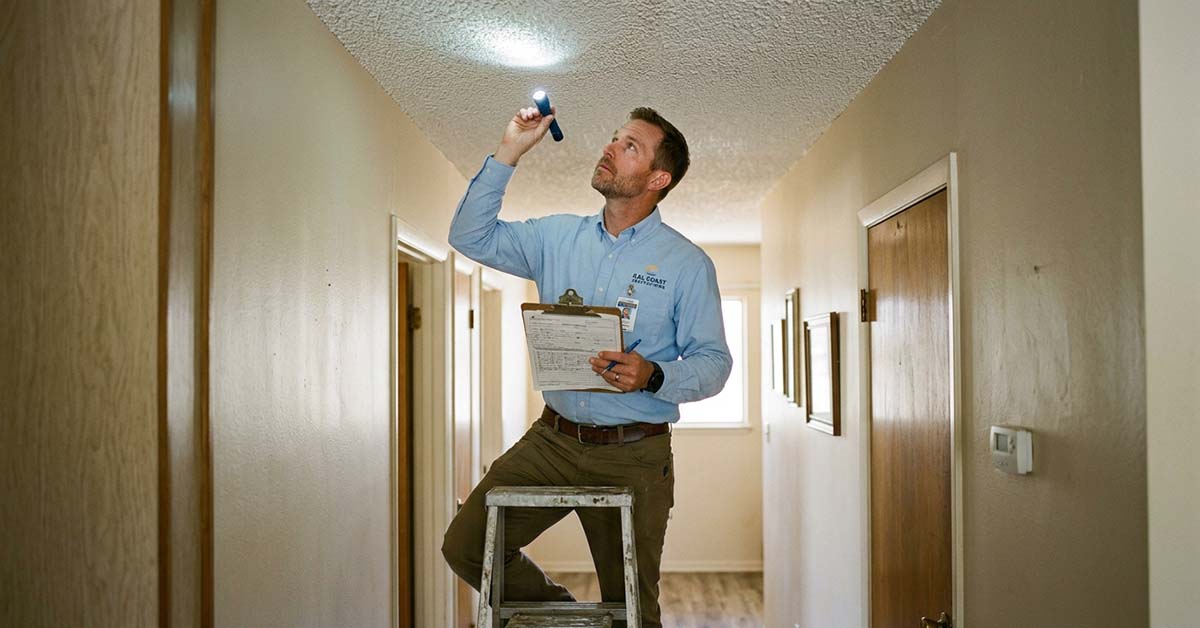
Asbestos is one of the most common—and most misunderstood—legacy hazards in California’s older housing stock. As an InterNACHI-certified home inspector, I see suspect materials in nearly every pre-1980 home I walk through, and one of the most useful things I can do during a buyer’s inspection is help homeowners understand what they are looking at: where asbestos was used, why it can be hazardous, what a visual inspection can and cannot tell them, and when a referral to a specialist is the right next step.
This article is a guide to recognizing the materials that warrant suspicion in older California homes. It is not a guide to disturbing, removing, or testing them—those are jobs for accredited inspectors and licensed abatement contractors, not homeowners and not general inspectors.
What Asbestos Is and Why It Matters
Asbestos is a family of naturally occurring fibrous silicate minerals that were used heavily in American building products from roughly the 1930s through the late 1970s. The fibers are durable, fire-resistant, and excellent insulators—qualities that made them attractive for thousands of products before the health risks were understood.
When asbestos-containing materials are intact and undisturbed, they pose minimal risk. The hazard arises when fibers become friable—able to be crumbled, pulverized, or reduced to powder by hand pressure—and become airborne, where they can be inhaled. Inhaled fibers lodge in lung tissue and can cause asbestosis (lung scarring), lung cancer, and mesothelioma, a rare cancer that is almost exclusively associated with asbestos exposure. There is no known safe exposure threshold, which is why intact asbestos-containing materials are typically managed in place rather than removed unless a renovation, remodel, or known damage forces the issue.
Federal regulation began ramping up in the 1970s. The EPA’s 1973 ban on spray-applied asbestos-containing materials for fireproofing and insulation was the first major restriction; the 1978 ban extended to spray-applied products not covered in 1973, including most decorative ceiling textures. Successive federal rules through the 1970s and 1980s phased out asbestos in many other building products. California adds its own regulatory layer. Cal/OSHA requires contractors to register with its Asbestos Contractor Registration Unit when performing work involving 100 square feet or more of asbestos-containing material (with asbestos content above 0.1%); below that, a “report of use” suffices. Each California air district enforces its own demolition-and-renovation rule on top of the federal NESHAP framework—Ventura County is governed by VCAPCD Rule 62.7, while Los Angeles, Orange, Riverside, and San Bernardino counties fall under the South Coast Air Quality Management District’s Rule 1403. Both rules require notification to the district before any project disturbing 100 or more square feet of asbestos-containing material, and both require that licensed asbestos abatement contractors perform the removal.
The practical takeaway: asbestos was used widely, the use ramped down through the 1980s, and homes built before about 1980 are statistically likely to contain at least one asbestos-suspect material somewhere. After about 1990, the probability drops sharply but is not zero, because some products continued to be manufactured legally and existing stock kept shipping for years.
Where Asbestos Hides in Older California Homes
These are the materials I look at most carefully during inspections of pre-1980 homes, and the ones I most often note as “suspect, recommend testing prior to disturbance.” The general visual home inspection is not a substitute for an asbestos specialist testing.
Popcorn (Acoustic) Ceilings
The textured spray-applied ceiling finish ubiquitous in homes built or remodeled from roughly the late 1950s through the late 1970s frequently contained chrysotile asbestos. The 1978 EPA ban on spray-applied products that had not already been covered by the 1973 fireproofing-and-insulation rule swept most decorative popcorn ceilings into prohibition, but existing inventory continued to be installed for years afterward. Any popcorn ceiling in a home built before about 1985 should be treated as suspect until a sample has been tested by an accredited laboratory. The risk is low when the ceiling is intact and painted; it climbs sharply when the surface is scraped, sanded, water-damaged, or removed during a remodel.
Vinyl Flooring and Mastic
Vinyl floor tile, particularly the common 9-inch by 9-inch tiles installed from the 1950s into the 1970s, frequently contained asbestos as a reinforcing fiber. The black mastic adhesive used to glue tiles to subfloors also commonly contained asbestos. Sheet vinyl and linoleum from the same era can have asbestos in the backing layer. Intact tile under newer flooring is usually low-risk; the hazard arises when someone tries to remove the old layer with a scraper or sander.
Vermiculite Attic Insulation
Loose-fill vermiculite—pebble-like, gray-brown, often shimmery—was used as attic insulation in California homes from roughly the 1940s into the 1980s. The dominant brand was Zonolite, and roughly 70 percent of all U.S. vermiculite came from a mine near Libby, Montana that was contaminated with tremolite asbestos. Any vermiculite in a California attic should be treated as asbestos-containing until tested. This is a category where I am especially careful during inspection: if observed, I will note its presence, photograph it from the attic hatch, and explicitly further evaluation and possible remediation by a qualified specialist.
Pipe Insulation and Boiler Wraps
Older homes—particularly pre-1970 construction—sometimes have white, fibrous wrapping around hot water and steam pipes, often with a corrugated cardboard-like profile and a canvas outer layer. This material commonly contains amosite or chrysotile asbestos. I flag any of it I see in basements, crawlspaces, mechanical closets, or attic chases.
Cement-Asbestos Products
Asbestos cement (often called “transite”) was used in roof shingles, siding panels, flue pipes, water lines, and chimney liners from the 1940s through the 1970s. These products are typically non-friable—the fibers are bound in a hard cement matrix—but become friable when broken, drilled, sanded, or weathered to deterioration.
Joint Compound, Plaster, and Texture
Drywall joint compound, plaster, and wall textures manufactured before the late 1970s sometimes contained chrysotile asbestos. This is one of the most commonly overlooked categories during remodels, because most homeowners and even some contractors do not think of “the mud on the seams” as a potential asbestos source.
Roofing and Siding Felt
Asphalt-saturated felt underlayment used under roof shingles or behind exterior siding sometimes contained chrysotile through the 1970s. Most weathered roofing felt is encapsulated in tar and not friable, but tearing off an old roof generates dust that warrants caution.
Other Suspect Materials
- Heat shields behind wood-burning stoves
- Asbestos-cement boards behind kitchen ranges
- Older HVAC duct tape and duct lining
- Linoleum backings
- Window glazing putty in some pre-1980 windows
- Decorative plaster or “popcorn” finishes on walls (less common than ceilings, but they exist)
What a Home Inspection Can and Cannot Tell You
This is the most important section in this article, because there is widespread confusion about what a general home inspection delivers when it comes to asbestos.
A home inspection is a visual, non-invasive evaluation. As an InterNACHI inspector, I can:
- Identify suspect materials by appearance, age, and context
- Note their condition—intact and stable versus damaged, friable, or actively shedding
- Photograph and document their location for the report
- Recommend testing prior to disturbance if the material is in an area likely to be remodeled, repaired, or removed
- Recommend abatement consultation if material is already damaged or otherwise warrants immediate attention
What a home inspection cannot do:
- Confirm the presence of asbestos. That requires a sample collected and analyzed by an accredited laboratory using polarized light microscopy or transmission electron microscopy. Visual identification alone—even by an experienced inspector—is not definitive. Materials that look identical can be asbestos-containing in one home and asbestos-free in the home next door, depending on the manufacturer and date of installation.
- Quantify exposure risk. Air sampling and bulk sampling are specialty services performed by accredited inspectors and analyzed by licensed labs.
- Authorize disturbance, removal, or abatement. All of that work belongs to specialists licensed and registered through Cal/OSHA’s Asbestos Contractor Registration Unit, the California Contractors State License Board (under the C-22 Asbestos Abatement classification), and the local air pollution control district that has jurisdiction—VCAPCD in Ventura County, SCAQMD in the four-county South Coast basin.
If a buyer asks me, “Is there asbestos in this house?” the honest answer is, “There are several materials in this house that warrant testing if you plan to disturb them. Here is where they are. Here is who to call before any of them gets touched.”
When Testing or Abatement Is Worth Pursuing
Asbestos that is intact and not in a location subject to disturbance is generally managed in place. The question is rarely “do we need to remove this?” and more often “what do we need to do before we remodel, repaint, re-roof, or refinish?”
Categories where I most often recommend testing during a real estate transaction:
- Vermiculite attic insulation in any home where the buyer is considering attic work, electrical upgrades, or insulation replacement
- Popcorn ceilings in any home built before about 1985, especially when the buyer plans to remove, smooth, or paint them
- Old vinyl flooring when a remodel is planned that involves removing the floor
- Pipe wrap in basements, crawlspaces, or mechanical rooms when re-piping or HVAC work is being considered
- Damaged or deteriorating suspect materials in any location, regardless of remodel plans
For a broader picture of issues that surface in older California housing stock alongside asbestos, see our overview of common issues in older California homes.
For Buyers
If you are considering an offer on a pre-1980 California home, factor an asbestos contingency into your due diligence the same way you would factor in a sewer scope or a Section 1 pest inspection. Ask your inspector to specifically call out suspect materials in the report. If you intend to remodel after closing, set aside budget for laboratory testing of any material you plan to disturb, and budget further for licensed abatement on anything that comes back positive. The cost of testing is small. The cost of doing remodel work without testing—both legally and to your family’s health—can be very large.
For Sellers
California’s Transfer Disclosure Statement asks about known hazardous conditions, and a known asbestos issue must be disclosed. If you have prior abatement records, gather them. If you suspect material is present but have no testing or abatement history, you generally are not required to commission testing solely to facilitate the sale, but disclosing the home’s age and the presence of suspect materials is always the safer path. A pre-listing inspection can help you understand what may surface during the buyer’s inspection so you are not caught off guard.
The Value of a Ventura County InterNACHI Inspection
Asbestos is one of the clearest examples of why a thorough InterNACHI inspection matters more than a fast one. A hurried inspection might note “popcorn ceiling—original to home” and move on. A careful one identifies every category of suspect material in the house, photographs each one, notes its condition, and gives the homeowner a coherent picture of what to test before any disturbance and what to manage in place. Our team has walked through hundreds of pre-1980 homes in Ventura, Oxnard, Camarillo, Ojai, and Thousand Oaks, and we know what to look for in each era’s construction.
Inspection Disclaimer
InterNACHI inspections are visual, non-invasive evaluations conducted in accordance with the Standards of Practice. Inspectors document materials that may be asbestos-suspect based on age, appearance, and context but do not collect samples, perform laboratory analysis, or quantify hazard. If the home contains one type of suspected asbestos, it may contain others not mentioned in the report. Sampling, testing, and any disturbance, removal, or abatement of asbestos-containing materials must be performed by accredited inspectors, accredited laboratories, and contractors registered and licensed for asbestos work through Cal/OSHA, the CSLB, and applicable air-quality districts.
Buying or selling a pre-1980 home in Ventura County or Southern California? Schedule your InterNACHI home inspection today—a careful read of suspect materials in your house is one of the most valuable parts of the inspection you’ll receive.