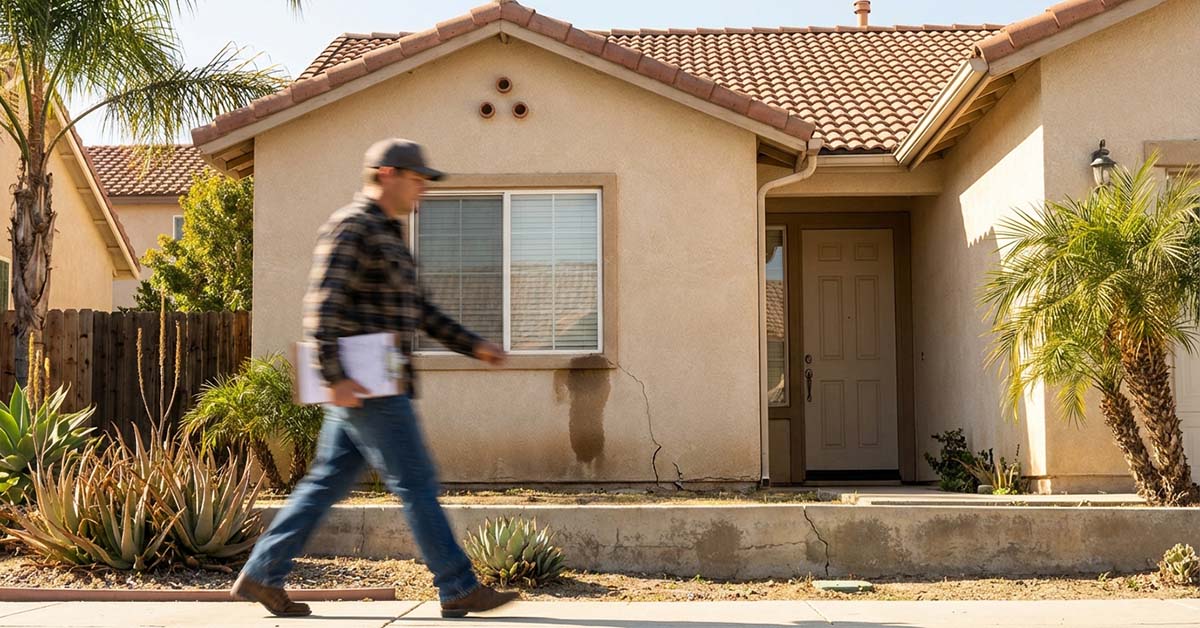
Imagine you’re buying a home in Ventura County. Your agent tells you they know a great inspector—fast, affordable, easy to work with. The inspector shows up, walks through the house in about 40 minutes, and gives a thumbs up. The report is brief, mostly checkboxes, and flags nothing major. You close on the property feeling confident.
Eight months later, you’re staring at a crawlspace full of standing water, a subpanel with double-tapped breakers and missing knockouts, and a roof with deteriorated flashing that’s been quietly funneling water into your attic. The repair estimates total $28,000. You call the inspector. Their phone number is disconnected. Their website is gone. You’re on your own.
This isn’t a hypothetical. Variations of this story play out across California every year, and a troubling pattern sits at the center of it: inspectors who race through properties in a fraction of the time a proper inspection requires, often at the recommendation of the real estate agent facilitating the sale. It’s a problem that the home inspection industry has been aware of for years, and California’s regulatory environment makes the state uniquely vulnerable to it.
What a Real Home Inspection Actually Looks Like
Before we talk about what’s going wrong, it helps to understand what a thorough inspection looks like when it’s done right.
A standard home inspection for a typical single-family home takes somewhere between two and four hours, depending on the size, age, and condition of the property. During that time, the inspector is systematically evaluating the roof, attic, structural components, foundation, exterior surfaces, grading and drainage, windows and doors, the garage, the electrical system (including the main panel), plumbing supply and drain lines, the water heater, HVAC systems, the kitchen, bathrooms, interior rooms, and the crawlspace or basement if present.
This isn’t a casual walkthrough. It involves climbing on roofs or using ladders and binoculars for overhead assessment, removing electrical panel covers to inspect wiring, entering crawlspaces, checking attic insulation and ventilation, running all the faucets, testing outlets, operating the HVAC system, looking at the water heater for signs of age or failure, and documenting everything with photographs and written descriptions.
The end product is a detailed written report—often 30 to 60 pages or more—that documents the condition of every major system and component, flags material defects, explains what’s significant, and recommends next steps where needed. This report is the buyer’s primary tool for understanding what they’re purchasing. It’s what you negotiate from. It’s what your contractor references when making repairs. It’s what protects you.
An inspection that takes 30 or 45 minutes cannot do any of this. It’s physically impossible to evaluate all of these systems in that timeframe. What you’re getting in a rushed inspection is, at best, someone glancing at the most visible surfaces and checking a few boxes. At worst, you’re getting a document designed to look like an inspection report that was never intended to find anything.
The Financial Incentive Nobody Talks About
To understand why rushed inspections exist, you need to understand the financial dynamics of a real estate transaction.
A real estate agent’s income comes from commissions, typically a percentage of the home’s sale price. On a $700,000 home in Ventura County, that commission can be significant. The agent only gets paid when the deal closes. Everything between the accepted offer and the closing date is, from the agent’s financial perspective, a potential obstacle.
The home inspection is the single most common reason real estate deals fall through or get renegotiated. When an inspector identifies a major problem—a failing foundation, an outdated electrical system, a roof nearing the end of its life—the buyer may renegotiate the price, request costly repairs, or walk away entirely. Any of those outcomes costs the agent time and money.
This creates an inherent tension. Most real estate agents are ethical professionals who genuinely want their clients to make informed decisions. But the financial incentive structure means that a thorough, detail-oriented inspector is, in some agents’ eyes, a threat. The industry even has a term for inspectors who consistently produce detailed reports that lead buyers to renegotiate or reconsider: “deal killers.”
The label isn’t used for inspectors who fabricate problems or exaggerate issues. It’s used for inspectors who do their jobs well. And once an inspector earns the deal killer reputation in a local market, referrals from agents can dry up quickly—which is devastating for inspectors whose business depends on those referrals.
The inspectors who thrive in this referral ecosystem are often the ones who are fast, inexpensive, and unlikely to flag anything that threatens the sale. Some of these inspectors are simply less experienced or less thorough. But some have made a deliberate calculation: keep the agents happy, keep the referrals coming, and don’t look too closely at anything that might complicate the transaction.
The Rise of “Walk-and-Talk” Inspections
In competitive real estate markets, a trend has emerged that takes this problem to its extreme: the “walk-and-talk” inspection.
A walk-and-talk is an abbreviated property review, typically lasting between 15 and 30 minutes, where an inspector accompanies the buyer during a showing and verbally points out potential concerns. There’s usually no written report, no use of specialized tools, no panel covers removed, no crawlspace entry, and no roof assessment beyond what you can see from the ground.
Walk-and-talks originally emerged as a compromise for buyers in extremely competitive markets who felt pressured to waive their inspection contingency entirely. The idea was that getting some professional input was better than none at all. And in that narrow context—when the alternative is truly zero inspection—there’s an argument for their value.
The problem is that walk-and-talks are increasingly being used not as a supplement, but as a replacement for full inspections. And in some cases, they’re being actively promoted by agents who want to minimize the risk of deal-disrupting findings.
Because walk-and-talks produce no written report, you have no documentation to negotiate from, no record of what was or wasn’t examined, and critically, no legal recourse if something major was missed. The inspector isn’t performing an inspection under any recognized standard of practice, so they generally can’t be held to inspector standards. You’ve paid for a conversation, and that’s what you got.
For buyers, this is an enormous amount of risk to take on for the largest purchase of their lives. For the agents and inspectors facilitating these arrangements, the risk is minimal—which is exactly the problem.
Why California Is Uniquely Exposed
Every state handles home inspector regulation differently. Some require extensive training, licensing exams, continuing education, insurance, and ongoing oversight. California is not one of those states.
California does not require a license to work as a home inspector. There is no state exam. There are no mandated training hours. There is no continuing education requirement. There is no state licensing board that oversees inspector conduct. Essentially, anyone who wants to call themselves a home inspector in California can do so tomorrow. There is no barrier to entry.
The state does have the California Trade Practice Act, Chapter 338, enacted in 1996. This law provides some important protections. It prohibits inspectors from repairing properties they’ve inspected within the previous 12 months, which addresses one form of conflict of interest. And notably, it prohibits an inspector from accepting an engagement where their fee or employment is contingent upon the conclusions of the report or the close of escrow. An inspector who is effectively being paid to produce a clean report—or whose continued referral relationship depends on not finding problems—is operating in tension with this statute.
The law also directs courts to consider the Standards of Practice of ASHI (the American Society of Home Inspectors) and CREIA (the California Real Estate Inspection Association) when evaluating whether an inspection met the required standard of care. This means that even though California doesn’t require inspectors to follow any particular standard, those standards become relevant if a dispute goes to court.
But here’s the catch: enforcement of the Trade Practice Act is entirely through private litigation. There’s no licensing board to file a complaint with. There’s no regulatory body conducting audits or investigations. If your inspector rushed through the job and missed $30,000 worth of problems, your only option is to hire a lawyer and sue—and if the inspector doesn’t carry errors and omissions insurance (which California also doesn’t require), there may be nothing to recover even if you win.
This combination—no licensing requirement, no oversight body, and enforcement only through costly private lawsuits—creates an environment where unqualified or unethical inspectors face almost no consequences. For an inspector working the referral pipeline with agents who want fast, clean reports, there’s very little downside to cutting corners.
Red Flags Every California Buyer Should Watch For
Knowing this landscape, here’s what should raise your concern when selecting a home inspector:
The inspection is scheduled for under 90 minutes. For a standard single-family home, anything under two hours is insufficient. If your inspector is promising to be in and out in 45 minutes, ask yourself what they’re skipping.
No written report is provided. A verbal summary is not a home inspection. You need detailed written documentation with photos to negotiate effectively, plan repairs, and have legal standing if problems emerge later.
The inspector was strongly recommended by the selling agent. This is the most important red flag. A selling agent has a financial interest in the deal closing smoothly. Their “favorite” inspector may be their favorite precisely because that inspector doesn’t create obstacles. You should always choose your own inspector independently.
The inspector also offers repair or contracting services. This is a direct conflict of interest, and under the California Trade Practice Act, an inspector cannot repair properties they’ve inspected within the prior 12 months. If someone offers to inspect your prospective home and then fix whatever they find, walk away.
The fee is well below market rate. Professional inspections for a typical California home generally range from $400 to $700 or more depending on size and scope. Prices significantly below that range should prompt questions about what’s being excluded.
The inspector has no verifiable credentials. Since California doesn’t issue licenses, look for voluntary professional certifications from recognized organizations like InterNACHI, ASHI, or CREIA. Ask for their certification number and verify it independently. Also ask whether they carry errors and omissions insurance—a reputable inspector will, even though it’s not required by the state.
The inspector discourages you from attending. You have every right to be present during the inspection, and a good inspector will welcome you. If someone prefers you not be there, ask why.
The report is vague or lacks photos. Checkbox-style reports with little narrative explanation and no photographic documentation are often signs of a superficial inspection. A proper report should make the property’s condition clear to someone who has never been inside it.
How to Protect Yourself
The good news is that protecting yourself isn’t complicated. It requires a little effort upfront, but the payoff—in avoided costs, negotiating power, and peace of mind—is enormous.
Choose your own inspector. Don’t default to the agent’s recommendation. Ask friends, family, or coworkers who’ve recently purchased homes. Look for online reviews. Do your own research. The person evaluating the biggest purchase of your life should be someone you selected based on qualifications, not someone your agent suggested for convenience.
Verify credentials independently. If an inspector claims InterNACHI certification, check the InterNACHI directory. If they claim ASHI membership, verify it on the ASHI site. If they claim CREIA membership, confirm it through CREIA. Don’t take anyone’s word for it.
Ask about their process before booking. How long will the inspection take? What systems do they evaluate? What tools do they use? Do they enter the crawlspace? Do they get on the roof or use alternative methods to assess it? Do they remove the electrical panel cover? What does their report look like? These questions will quickly reveal whether someone is conducting a serious inspection or just going through the motions.
Attend the inspection. This is your opportunity to learn about the home you’re buying from someone whose only job is to tell you the truth about it. Walk with the inspector. Ask questions. A quality inspector will treat this as a teaching opportunity, not an inconvenience.
Request a sample report before hiring. Any professional inspector should be happy to provide one. If the sample is thin, vague, or lacks detail, that tells you what your report will look like.
Don’t let timeline pressure override due diligence. In competitive markets, there’s always pressure to move fast. But a rushed decision on your inspector can cost you many times what you’d save in time. Even in a hot market, taking an extra day or two to secure a qualified inspector is almost always worth it.
Keep the cost in perspective. A thorough professional inspection in California typically runs somewhere between $400 and $700. The median home price in Ventura County is well over $800,000. That means the inspection represents roughly 0.05% to 0.09% of your purchase price—a rounding error on the transaction. Yet it’s the single best tool you have for uncovering problems that could cost tens of thousands of dollars to repair. A buyer who opts for a $200 rushed inspection over a $500 comprehensive one isn’t saving $300. They’re gambling that nothing expensive is hiding behind the walls, under the foundation, or on the roof. On a purchase this large, that’s not frugality—it’s one of the most expensive decisions you can make.
Why Best Coast Inspections Does Things Differently
At Best Coast Inspections, our inspections take the time they need—because that’s the only way to do them right. We don’t cut corners to keep anyone’s timeline comfortable, and we don’t soften reports to keep referral pipelines open.
TK Erwin, our founder and lead inspector, brings hands-on construction experience that includes property management, ground-up new construction from permitting through certificate of occupancy, and designing and building his own home here in Ventura County. That real-world building knowledge is backed by rigorous professional credentials: TK is a Certified Professional Inspector through InterNACHI, has passed the National Home Inspector Exam, and completes continuing education annually to stay current on building science, materials, and inspection techniques.
Our reports are comprehensive, clearly written, and packed with photos and detailed explanations—because a report is only useful if you can understand it and act on it. We follow InterNACHI’s Standards of Practice and Code of Ethics, which means our inspections are systematic, our findings are honest, and we have no financial interest in the outcome of your transaction. We work for you, the buyer, and nobody else.
We know that in a state with no licensing requirements, trust has to be earned. That’s why we’ve written extensively on this blog about what InterNACHI certification actually means and why it matters in California’s unregulated market. It’s why we make our sample reports available so you can see the level of detail we provide before you book. And it’s why we welcome—and encourage—every client to attend their inspection in person.
The 30-Minute Inspection: How Rushed Reports Are Putting California Homebuyers at RiskIf you’re purchasing a home in Ventura County and want an inspection you can trust, reach out to us. We’d rather spend three hours finding problems than thirty minutes pretending they don’t exist.